
Awards
Winners
Nominees
Sites of the Day
Sites of the Month
Inspiration
Collections
Elements
Blog
Articles
Directory
Professionals
Internationals
Freelancers
Agencies & Studios
Academy
Courses
Jobs & Jury
Jobs
Jury
Menu
0

Awards
Winners
Nominees
Sites of the Day
Sites of the Month
Inspiration
Collections
Elements
Blog
Articles
Directory
Professionals
Internationals
Freelancers
Agencies & Studios
Academy
Courses
Jobs & Jury
Jobs
Jury
Menu
0
Awards
Winners
Nominees
Sites of the Day
Sites of the Month
Inspiration
Collections
Elements
Blog
Articles
Directory
Professionals
Internationals
Freelancers
Agencies & Studios
Academy
Courses
Jobs & Jury
Jobs
Jury
Menu
0

Brain Fog in Perimenopause & Menopause
Brain Fog in Perimenopause & Menopause
"I walked into a room and completely forgot why I was there. I'd open my laptop to do something important and just stare at it. Words I'd used my entire professional life suddenly wouldn't come to me. My doctor said it was just part of getting older, but I'm only 47."
"I walked into a room and completely forgot why I was there. I'd open my laptop to do something important and just stare at it. Words I'd used my entire professional life suddenly wouldn't come to me. My doctor said it was just part of getting older, but I'm only 47."
2026/2/5
2026/2/5
"I walked into a room and completely forgot why I was there. I'd open my laptop to do something important and just stare at it. Words I'd used my entire professional life suddenly wouldn't come to me. My doctor said it was just part of getting older, but I'm only 47."
A patient told me this last month. She's a successful executive who'd never struggled with her cognitive abilities before. She was scared she was developing early dementia. She'd been to three doctors, all of whom offered some version of "it's just menopause" or "stress" or "part of aging."
Here's what I told her: You're not losing your mind. You're not imagining this. And no, you don't have to accept this as your new normal.
As a male physician, I'll be the first to admit I don't experience perimenopause personally. But I've treated hundreds of women through this transition, and I've seen how profoundly hormonal changes can affect cognitive function, and how inadequately medicine often addresses it.
What's Actually Happening in Your Brain
Perimenopausal and menopausal brain fog is real. It's not just stress. It's not you being dramatic. It's not normal aging. Women in their 40s and early 50s shouldn't be experiencing significant cognitive decline. It's a physiological response to dramatic hormonal shifts.
Estrogen isn't just a reproductive hormone. It's a powerful neuromodulator. Your brain has estrogen receptors throughout, particularly in areas controlling memory, attention, and executive function. Estrogen affects neurotransmitter production (serotonin, dopamine, acetylcholine), cerebral blood flow (how much blood reaches your brain), neuroplasticity (your brain's ability to form new connections), mitochondrial function (energy production in brain cells), and glucose metabolism (how your brain uses its primary fuel).
When estrogen levels fluctuate wildly during perimenopause or drop significantly at menopause, all of these functions are affected. Your brain is adjusting to operating with different neurochemical conditions.
Why Perimenopause Often Feels Worse Than Menopause
Many women find perimenopause more challenging than menopause itself. This makes physiological sense.
During perimenopause, hormone levels don't just decline. They fluctuate dramatically and unpredictably. Your estrogen might spike high one week, causing anxiety and headaches, and crash the next, causing brain fog and fatigue. This volatility is often harder on cognitive function than the stable, lower levels of post-menopause.
Think of the difference between adjusting to living at high altitude, which is challenging but allows adaptation, versus constantly going up and down a mountain, where your body never fully adjusts. The unpredictability of perimenopause makes it particularly difficult.
Post-menopause, many women find their brain fog improves somewhat as hormone levels stabilize at lower levels. The brain adapts to the new baseline. But during the transition, which can last four to eight years, cognitive symptoms can be severe.
The Full Spectrum of What You Might Experience
Women describe a range of specific cognitive changes during this transition.
Memory issues include word-finding difficulties where something is constantly on the tip of your tongue, forgetting why you walked into a room, difficulty remembering names even of people you know well, and losing track of conversations mid-sentence.
Attention and focus problems include inability to concentrate on complex tasks, reading the same paragraph multiple times without comprehension, getting easily distracted, and difficulty multitasking when you used to do it effortlessly.
Executive function challenges include trouble organizing and planning, decision-making feeling overwhelming, difficulty prioritizing tasks, and mental processing feeling slow like thinking through mud.
The emotional component makes perimenopausal brain fog particularly distressing. These aren't just cognitive symptoms. They affect your sense of self. Professional women who've built careers on their mental sharpness suddenly feel incompetent. The internal monologue becomes harsh. What's wrong with me? I used to be so sharp. Am I losing it?
This is compounded when medical encounters feel dismissive. When doctors don't take your symptoms seriously, you start doubting yourself, even though what you're experiencing is entirely real.
Why Standard Medical Care Often Falls Short
Women with legitimate, distressing cognitive symptoms are frequently dismissed or inadequately supported. The reasons are structural.
Saying "it's just menopause" without offering solutions is like telling someone with a broken leg "it's just a fracture" and sending them home without a cast. Identifying the cause doesn't make the symptom less real or less deserving of treatment.
Some doctors offer only hormone replacement therapy. While HRT can be helpful for many women and absolutely should be discussed with your OB-GYN or hormone specialist, it's not the only option and it's not right for everyone. Many women have contraindications to HRT (personal or family history of breast cancer, blood clots), don't want to take hormones for personal reasons, try HRT but still experience cognitive symptoms, or want additional support alongside HRT. These women need options beyond "take hormones or live with it."
The fundamental problem is that perimenopausal cognitive symptoms fall between specialties. Your OB-GYN focuses on reproductive symptoms. Your primary care doctor is managing fifteen other things in a 15-minute appointment. Neurologists typically see you only if there's concern about dementia. No one is specifically focused on supporting your brain through this hormonal transition, even though that's exactly what needs support.
What Actually Helps
Multiple evidence-based approaches can significantly improve perimenopausal and menopausal brain fog. You don't have to just endure this.
Sleep and stress form the foundation. Declining estrogen affects sleep quality directly. You may experience more night sweats, insomnia, or disrupted sleep. Poor sleep dramatically worsens cognitive function. And the cognitive symptoms themselves create stress, which further disrupts sleep. Breaking this cycle matters.
Keep your bedroom cool since this helps with night sweats. Maintain consistent sleep-wake times. Consider magnesium glycinate before bed since it improves sleep quality and supports hormone metabolism. If night sweats are severe, discuss options with your doctor since this is one area where HRT can be particularly helpful.
Nutritional support addresses your brain's increased needs during hormonal transitions. Certain nutrients become even more important.
B vitamins (B2, B3, B12) are needed for energy production in brain cells and neurotransmitter function. Methylated forms are better absorbed. Estrogen decline affects how your body uses B vitamins, so requirements increase.
Magnesium supports calm neuronal signaling, sleep quality, and helps metabolize hormones. Many women are deficient. Magnesium glycinate is the best-absorbed form.
Vitamin D3 supports neurotrophic signaling and mood regulation. Deficiency is common and worsens cognitive symptoms.
Antioxidants like NAC and curcumin help protect brain cells from oxidative stress, which increases during hormonal transitions. They support healthy inflammatory balance.
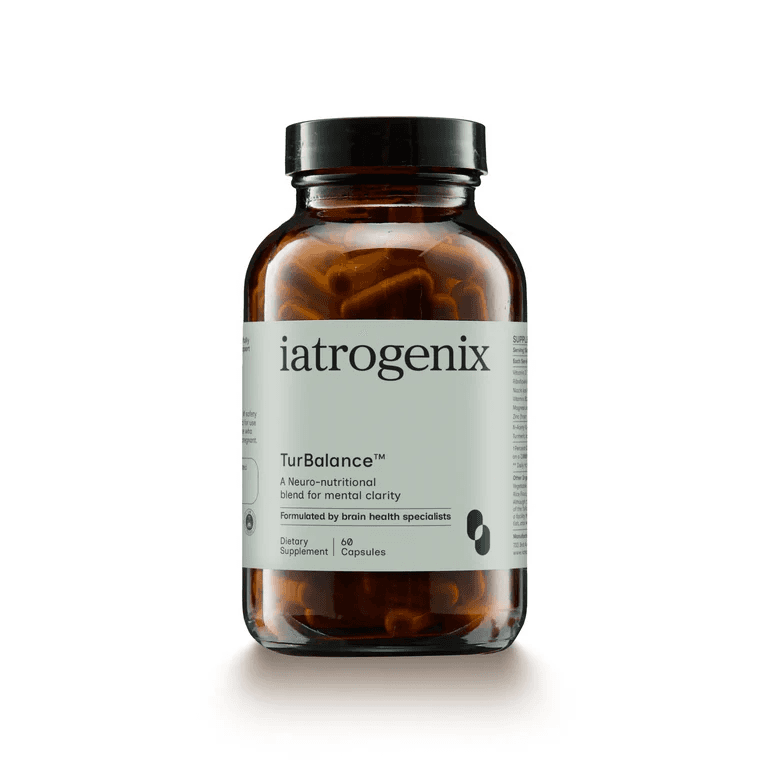
You can get these through diet and individual supplements, or through a comprehensive formulation designed for cognitive support. At Iatrogenix, we developed TurBalance specifically for this purpose, combining these nutrients at therapeutic doses without hormones. But whatever approach you use, targeted nutritional support can be a meaningful component of managing this transition.
Physical activity has direct cognitive benefits that are especially important now. Exercise increases BDNF (brain-derived neurotrophic factor), which supports brain cell health. It improves insulin sensitivity, which helps with glucose metabolism in the brain. It reduces inflammation, improves sleep quality, and supports mood regulation.
You don't need intense workouts. Even 30 minutes of brisk walking five days a week has measurable cognitive benefits. Strength training is particularly valuable since it helps maintain muscle mass and supports metabolic health.
When to Consider Hormone Replacement Therapy
I don't prescribe HRT since that's appropriately done by OB-GYNs and hormone specialists. But I can tell you when patients in my practice benefit from discussing it with their doctors: severe symptoms significantly impacting quality of life, multiple menopausal symptoms (cognitive plus hot flashes, night sweats, vaginal dryness), early menopause before age 45 where longer-term health risks of estrogen deficiency are a concern, and cases where lifestyle and supplement interventions haven't provided adequate relief after three months.
HRT is a personal decision that depends on your individual health history, risk factors, symptom severity, and preferences. Have an honest conversation with a knowledgeable provider who will discuss both benefits and risks specific to your situation.
Even if you choose HRT, the nutritional and lifestyle supports discussed here will enhance its effectiveness. And if you can't take HRT or prefer not to, these interventions can still provide significant relief.
What to Expect: A Realistic Timeline
Recovery is gradual. Set realistic expectations because immediate improvement is rare, and knowing what's normal helps you stay consistent.
In weeks one and two, you probably won't notice dramatic changes. Some women report slightly better sleep or feeling less wired in the evening. Cognitive improvements typically take longer.
In weeks three and four, most women start noticing improvement in mental clarity. It's often subtle at first. You might realize you got through a work task without getting stuck, or you remembered something without really searching for it. Sleep quality often improves noticeably during this window.
By weeks six to eight, improvements become more consistent and noticeable. Word-finding is easier, concentration improves, mental processing speeds up. Most women feel like they're starting to feel like themselves again.
Over months three to six, full benefits emerge. Your brain has adapted to the new hormonal baseline with proper nutritional support. Cognitive function stabilizes at a much better level.
This timeline assumes you're addressing multiple factors, not just taking a supplement but also prioritizing sleep, managing stress, and staying physically active.
When to Seek Additional Help
Most perimenopausal brain fog improves with these approaches, but some situations warrant additional evaluation.
See your doctor if cognitive symptoms are rapidly worsening, you're experiencing confusion or disorientation, memory problems are severe enough to affect daily functioning, or you have concerning neurological symptoms like weakness, vision changes, or severe headaches.
Consider a hormone specialist consultation if symptoms are severely impacting quality of life, you're interested in HRT and want expert guidance, you have multiple severe menopausal symptoms, or you're experiencing early menopause before age 45.
You Deserve Better
If you've been dismissed, told "it's just menopause" without being offered solutions, or made to feel like you're overreacting, I want you to know: your symptoms are real, your concerns are valid, and you deserve comprehensive support.
Perimenopause and menopause are significant neurological transitions, not just reproductive ones. Your brain is adapting to profound hormonal changes, and it needs support during that adaptation.
With proper support, most women experience significant improvement. You don't have to accept cognitive decline as an inevitable part of this transition. There are evidence-based interventions, both lifestyle and nutritional, that can help you maintain mental clarity and feel like yourself.
You're not losing your mind. You're experiencing a physiological transition that affects brain function. And with the right support, you can navigate it successfully and come out the other side still feeling sharp, capable, and like yourself.
About the Author
Nicholas Tzikas, MD, MPH, is a fellowship-trained headache specialist and academic physician whose clinical and research interests focus on complex headache disorders, post-traumatic headache, and the cognitive symptoms that often accompany them. He is a nationally recognized Key Opinion Leader who advises pharmaceutical companies on therapeutic development and clinical trials.
Learn more at iatrogenix.com
Medical Disclaimer
This article is for educational and informational purposes only and is not intended as medical advice. Perimenopause and menopause affect every woman differently, and recommendations that work for some may not be appropriate for others.
Always consult with your healthcare provider before starting any new supplement regimen, making changes to existing medications, or making decisions about hormone replacement therapy. Discuss your specific symptoms, health history, and risk factors with qualified providers, including your OB-GYN, primary care doctor, or hormone specialist.
If you are experiencing severe cognitive changes, neurological symptoms, or symptoms that significantly impact your daily functioning, seek medical evaluation.
These statements have not been evaluated by the Food and Drug Administration. This product is not intended to diagnose, treat, cure, or prevent any disease.
"I walked into a room and completely forgot why I was there. I'd open my laptop to do something important and just stare at it. Words I'd used my entire professional life suddenly wouldn't come to me. My doctor said it was just part of getting older, but I'm only 47."
A patient told me this last month. She's a successful executive who'd never struggled with her cognitive abilities before. She was scared she was developing early dementia. She'd been to three doctors, all of whom offered some version of "it's just menopause" or "stress" or "part of aging."
Here's what I told her: You're not losing your mind. You're not imagining this. And no, you don't have to accept this as your new normal.
As a male physician, I'll be the first to admit I don't experience perimenopause personally. But I've treated hundreds of women through this transition, and I've seen how profoundly hormonal changes can affect cognitive function, and how inadequately medicine often addresses it.
What's Actually Happening in Your Brain
Perimenopausal and menopausal brain fog is real. It's not just stress. It's not you being dramatic. It's not normal aging. Women in their 40s and early 50s shouldn't be experiencing significant cognitive decline. It's a physiological response to dramatic hormonal shifts.
Estrogen isn't just a reproductive hormone. It's a powerful neuromodulator. Your brain has estrogen receptors throughout, particularly in areas controlling memory, attention, and executive function. Estrogen affects neurotransmitter production (serotonin, dopamine, acetylcholine), cerebral blood flow (how much blood reaches your brain), neuroplasticity (your brain's ability to form new connections), mitochondrial function (energy production in brain cells), and glucose metabolism (how your brain uses its primary fuel).
When estrogen levels fluctuate wildly during perimenopause or drop significantly at menopause, all of these functions are affected. Your brain is adjusting to operating with different neurochemical conditions.
Why Perimenopause Often Feels Worse Than Menopause
Many women find perimenopause more challenging than menopause itself. This makes physiological sense.
During perimenopause, hormone levels don't just decline. They fluctuate dramatically and unpredictably. Your estrogen might spike high one week, causing anxiety and headaches, and crash the next, causing brain fog and fatigue. This volatility is often harder on cognitive function than the stable, lower levels of post-menopause.
Think of the difference between adjusting to living at high altitude, which is challenging but allows adaptation, versus constantly going up and down a mountain, where your body never fully adjusts. The unpredictability of perimenopause makes it particularly difficult.
Post-menopause, many women find their brain fog improves somewhat as hormone levels stabilize at lower levels. The brain adapts to the new baseline. But during the transition, which can last four to eight years, cognitive symptoms can be severe.
The Full Spectrum of What You Might Experience
Women describe a range of specific cognitive changes during this transition.
Memory issues include word-finding difficulties where something is constantly on the tip of your tongue, forgetting why you walked into a room, difficulty remembering names even of people you know well, and losing track of conversations mid-sentence.
Attention and focus problems include inability to concentrate on complex tasks, reading the same paragraph multiple times without comprehension, getting easily distracted, and difficulty multitasking when you used to do it effortlessly.
Executive function challenges include trouble organizing and planning, decision-making feeling overwhelming, difficulty prioritizing tasks, and mental processing feeling slow like thinking through mud.
The emotional component makes perimenopausal brain fog particularly distressing. These aren't just cognitive symptoms. They affect your sense of self. Professional women who've built careers on their mental sharpness suddenly feel incompetent. The internal monologue becomes harsh. What's wrong with me? I used to be so sharp. Am I losing it?
This is compounded when medical encounters feel dismissive. When doctors don't take your symptoms seriously, you start doubting yourself, even though what you're experiencing is entirely real.
Why Standard Medical Care Often Falls Short
Women with legitimate, distressing cognitive symptoms are frequently dismissed or inadequately supported. The reasons are structural.
Saying "it's just menopause" without offering solutions is like telling someone with a broken leg "it's just a fracture" and sending them home without a cast. Identifying the cause doesn't make the symptom less real or less deserving of treatment.
Some doctors offer only hormone replacement therapy. While HRT can be helpful for many women and absolutely should be discussed with your OB-GYN or hormone specialist, it's not the only option and it's not right for everyone. Many women have contraindications to HRT (personal or family history of breast cancer, blood clots), don't want to take hormones for personal reasons, try HRT but still experience cognitive symptoms, or want additional support alongside HRT. These women need options beyond "take hormones or live with it."
The fundamental problem is that perimenopausal cognitive symptoms fall between specialties. Your OB-GYN focuses on reproductive symptoms. Your primary care doctor is managing fifteen other things in a 15-minute appointment. Neurologists typically see you only if there's concern about dementia. No one is specifically focused on supporting your brain through this hormonal transition, even though that's exactly what needs support.
What Actually Helps
Multiple evidence-based approaches can significantly improve perimenopausal and menopausal brain fog. You don't have to just endure this.
Sleep and stress form the foundation. Declining estrogen affects sleep quality directly. You may experience more night sweats, insomnia, or disrupted sleep. Poor sleep dramatically worsens cognitive function. And the cognitive symptoms themselves create stress, which further disrupts sleep. Breaking this cycle matters.
Keep your bedroom cool since this helps with night sweats. Maintain consistent sleep-wake times. Consider magnesium glycinate before bed since it improves sleep quality and supports hormone metabolism. If night sweats are severe, discuss options with your doctor since this is one area where HRT can be particularly helpful.
Nutritional support addresses your brain's increased needs during hormonal transitions. Certain nutrients become even more important.
B vitamins (B2, B3, B12) are needed for energy production in brain cells and neurotransmitter function. Methylated forms are better absorbed. Estrogen decline affects how your body uses B vitamins, so requirements increase.
Magnesium supports calm neuronal signaling, sleep quality, and helps metabolize hormones. Many women are deficient. Magnesium glycinate is the best-absorbed form.
Vitamin D3 supports neurotrophic signaling and mood regulation. Deficiency is common and worsens cognitive symptoms.
Antioxidants like NAC and curcumin help protect brain cells from oxidative stress, which increases during hormonal transitions. They support healthy inflammatory balance.
You can get these through diet and individual supplements, or through a comprehensive formulation designed for cognitive support. At Iatrogenix, we developed TurBalance specifically for this purpose, combining these nutrients at therapeutic doses without hormones. But whatever approach you use, targeted nutritional support can be a meaningful component of managing this transition.
Physical activity has direct cognitive benefits that are especially important now. Exercise increases BDNF (brain-derived neurotrophic factor), which supports brain cell health. It improves insulin sensitivity, which helps with glucose metabolism in the brain. It reduces inflammation, improves sleep quality, and supports mood regulation.
You don't need intense workouts. Even 30 minutes of brisk walking five days a week has measurable cognitive benefits. Strength training is particularly valuable since it helps maintain muscle mass and supports metabolic health.
When to Consider Hormone Replacement Therapy
I don't prescribe HRT since that's appropriately done by OB-GYNs and hormone specialists. But I can tell you when patients in my practice benefit from discussing it with their doctors: severe symptoms significantly impacting quality of life, multiple menopausal symptoms (cognitive plus hot flashes, night sweats, vaginal dryness), early menopause before age 45 where longer-term health risks of estrogen deficiency are a concern, and cases where lifestyle and supplement interventions haven't provided adequate relief after three months.
HRT is a personal decision that depends on your individual health history, risk factors, symptom severity, and preferences. Have an honest conversation with a knowledgeable provider who will discuss both benefits and risks specific to your situation.
Even if you choose HRT, the nutritional and lifestyle supports discussed here will enhance its effectiveness. And if you can't take HRT or prefer not to, these interventions can still provide significant relief.
What to Expect: A Realistic Timeline
Recovery is gradual. Set realistic expectations because immediate improvement is rare, and knowing what's normal helps you stay consistent.
In weeks one and two, you probably won't notice dramatic changes. Some women report slightly better sleep or feeling less wired in the evening. Cognitive improvements typically take longer.
In weeks three and four, most women start noticing improvement in mental clarity. It's often subtle at first. You might realize you got through a work task without getting stuck, or you remembered something without really searching for it. Sleep quality often improves noticeably during this window.
By weeks six to eight, improvements become more consistent and noticeable. Word-finding is easier, concentration improves, mental processing speeds up. Most women feel like they're starting to feel like themselves again.
Over months three to six, full benefits emerge. Your brain has adapted to the new hormonal baseline with proper nutritional support. Cognitive function stabilizes at a much better level.
This timeline assumes you're addressing multiple factors, not just taking a supplement but also prioritizing sleep, managing stress, and staying physically active.
When to Seek Additional Help
Most perimenopausal brain fog improves with these approaches, but some situations warrant additional evaluation.
See your doctor if cognitive symptoms are rapidly worsening, you're experiencing confusion or disorientation, memory problems are severe enough to affect daily functioning, or you have concerning neurological symptoms like weakness, vision changes, or severe headaches.
Consider a hormone specialist consultation if symptoms are severely impacting quality of life, you're interested in HRT and want expert guidance, you have multiple severe menopausal symptoms, or you're experiencing early menopause before age 45.
You Deserve Better
If you've been dismissed, told "it's just menopause" without being offered solutions, or made to feel like you're overreacting, I want you to know: your symptoms are real, your concerns are valid, and you deserve comprehensive support.
Perimenopause and menopause are significant neurological transitions, not just reproductive ones. Your brain is adapting to profound hormonal changes, and it needs support during that adaptation.
With proper support, most women experience significant improvement. You don't have to accept cognitive decline as an inevitable part of this transition. There are evidence-based interventions, both lifestyle and nutritional, that can help you maintain mental clarity and feel like yourself.
You're not losing your mind. You're experiencing a physiological transition that affects brain function. And with the right support, you can navigate it successfully and come out the other side still feeling sharp, capable, and like yourself.
About the Author
Nicholas Tzikas, MD, MPH, is a fellowship-trained headache specialist and academic physician whose clinical and research interests focus on complex headache disorders, post-traumatic headache, and the cognitive symptoms that often accompany them. He is a nationally recognized Key Opinion Leader who advises pharmaceutical companies on therapeutic development and clinical trials.
Learn more at iatrogenix.com
Medical Disclaimer
This article is for educational and informational purposes only and is not intended as medical advice. Perimenopause and menopause affect every woman differently, and recommendations that work for some may not be appropriate for others.
Always consult with your healthcare provider before starting any new supplement regimen, making changes to existing medications, or making decisions about hormone replacement therapy. Discuss your specific symptoms, health history, and risk factors with qualified providers, including your OB-GYN, primary care doctor, or hormone specialist.
If you are experiencing severe cognitive changes, neurological symptoms, or symptoms that significantly impact your daily functioning, seek medical evaluation.
These statements have not been evaluated by the Food and Drug Administration. This product is not intended to diagnose, treat, cure, or prevent any disease.
By Dr. Nicholas Tzikas, MD, MPH - Fellowship-trained headache specialist and co-founder of Iatrogenix
By Dr. Nicholas Tzikas, MD, MPH - Fellowship-trained headache specialist and co-founder of Iatrogenix
our journal
our journal
More insights for you.
More insights for you.
Explore more reflections, guidance, and practical tools to support your growth and well-being.
Explore more reflections, guidance, and practical tools to support your growth and well-being.

"I'm exhausted, but it's not the kind of tired that sleep fixes." A friend called me last week with that particular strain in her voice I've learned to recognize. "My body feels fine," she said. "But my brain is just... done. I can't think. I can't focus. And the harder I try to push through it, the worse it gets."

"I've tried four different brain fog supplements. None of them worked. Am I just choosing the wrong ones, or is this whole category a waste of money?"
Your questions.
Answered.
Not sure what to expect? These answers might help you feel more confident as you begin.
Didn’t find your answer? Send us a message — we’ll respond with care and clarity.
How is iatrogenix™ different from other brain health supplements?
What does “neuro-nutrition” mean?
Are iatrogenix™ products a replacement for prescription medication?
When will I start noticing results?
How do I know which product is right for me?
What is the 90-Day Protocol?
Can I take more than one iatrogenix™ formula at the same time?
Are iatrogenix™ products allergen-friendly?
Where are iatrogenix™ products made?
Where do you ship?
What is your return policy?
Why two forms of magnesium? (MigraMute)
Your questions.
Answered.
Not sure what to expect? These answers might help you feel more confident as you begin.
Didn’t find your answer? Send us a message — we’ll respond with care and clarity.
How is Iatrogenix different from other brain health supplements?
What does “neuro-nutrition” mean?
Are Iatrogenix products a replacement for prescription medication?
When will I start noticing results?
How do I know which product is right for me?
What is the 90-Day Protocol?
What’s the difference between MigraMute and TurBalance?
Can I take these products for general daily support?
Can I take more than one Iatrogenix formula at the same time?
Is Migramute allergen-friendly?
Where are Iatrogenix products made?
Where do you ship?
What is your return policy?
Your questions.
Answered.
Not sure what to expect? These answers might help you feel more confident as you begin.
Didn’t find your answer? Send us a message — we’ll respond with care and clarity.
How is iatrogenix™ different from other brain health supplements?
What does “neuro-nutrition” mean?
Are iatrogenix™ products a replacement for prescription medication?
When will I start noticing results?
How do I know which product is right for me?
What is the 90-Day Protocol?
Can I take more than one iatrogenix™ formula at the same time?
Are iatrogenix™ products allergen-friendly?
Where are iatrogenix™ products made?
Where do you ship?
What is your return policy?
Why two forms of magnesium? (MigraMute)